Best AI Tools for Digital Marketing in 2026: A Complete Guide for Beginners & Professionals
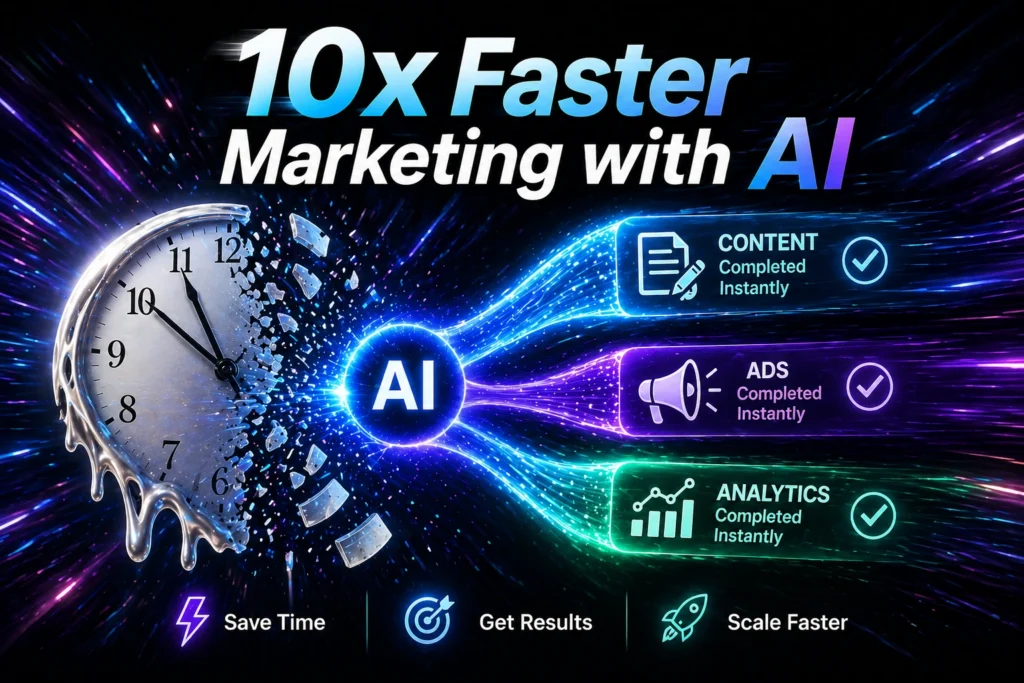
AI is no longer optional for marketers. From content creation and SEO to ads and automation — here’s everything you need to build an AI-powered marketing system that actually works.
Table of contents:
1: Why AI Tools Matter for Digital Marketers in 2026
2: Best AI Tools by Category — The Complete Stack
3: Which Tool Does What — Function Mapping
4: How AI Speeds Up Your Work — Real Efficiency Gains
5: How to Build an AI Marketing Workflow
6: Getting the Best Output — Prompting & Optimization
7: Limitations of AI Tools — The Honest Reality Check
8: AI Tools for Indian Marketers — Local Context
9: FAQs
Why AI Tools Matter for Digital Marketers in 2026
The marketing landscape in 2026 looks fundamentally different from just two years ago. AI tools are now used daily by over 70% of professional marketers — not as experiments, but as core parts of their workflow. Content that used to take a week now takes a day. Campaigns that required a full team can now be launched by a solo marketer with the right AI stack.
Whether you’re a marketing intern just starting out, a freelancer trying to serve more clients, or a small business owner managing your own presence — this guide breaks down the best tools, how to use them, and how to avoid the most common mistakes.
Best AI Tools for Digital Marketing in 2026 (by Category)
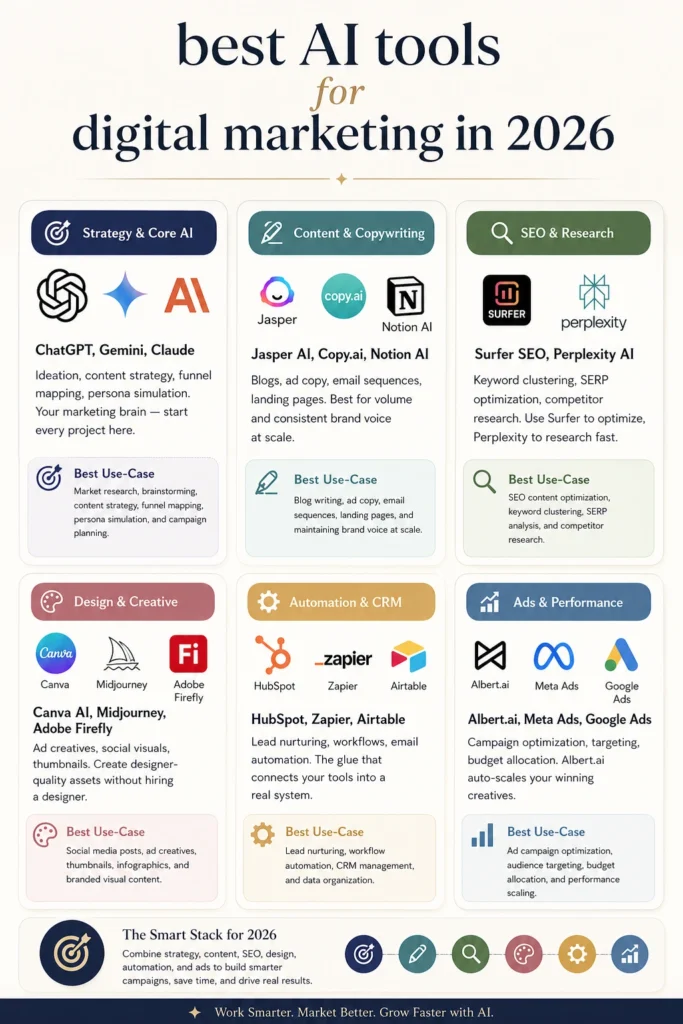
There is no single “best” AI tool for digital marketing — the right answer depends on what you need to do. Here’s a breakdown by category, so you can pick and build your stack intelligently.
KEY INSIGHTS
The best marketers don’t use just one tool — they build systems. Think of each tool as a specialist on your team, not a replacement for your entire strategy.
Which Tool Does What — Clear Function Mapping
Here’s the clearest way to think about the AI marketing stack: match your task to the right tool, and you’ll save hours every week.
| MARKETING FUNCTION | BEST TOOLS | PRACTICAL USE- CASE |
|---|---|---|
| Strategy & Planning | ChatGPT, Gemini | Build a full funnel strategy in minutes with the right prompt |
| Content Creation | Jasper, ChatGPT, Claude | Generate a 30-day content calendar with captions, hooks & CTAs |
| SEO Optimization | Surfer SEO | Optimize blog posts to rank faster with keyword density guidance |
| Competitor Research | Perplexity AI | Replace 10 browser tabs with one sharp, cited AI query |
| Visual Creatives | Canva AI, Midjourney, Gemini | Create scroll-stopping ad visuals without a design team |
| Lead Automation | Zapier, HubSpot | Auto-trigger email sequences from form submissions or CRM updates |
| Paid Ads Optimization | Albert.ai | Auto-allocate budget to winning ad sets across platforms |
How AI Speeds Up Your Work — Real Efficiency Gains
Let’s get specific. Here’s what the difference actually looks like when you integrate AI tools properly into a marketing workflow.
Speed gains
- Content production runs 3–4× faster compared to traditional workflows
- Campaign execution shrinks from days to hours when prompts and templates are ready
- Competitor and keyword research collapses from hours of browser tabs to minutes with Perplexity AI
Quality gains
- Hyper-personalization at scale — what Adobe calls “marketing to a segment of one” — becomes achievable even for small businesses
- Predictive analytics help you focus budget on the audience segments most likely to convert
- Automated A/B testing means you spend less time guessing and more time scaling what works
“Before AI: 1 blog per week. After AI: 5 optimized blogs per week — with better SEO and consistent brand voice.”
The shift isn’t just about doing the same work faster. It’s about doing work that was previously impossible for a solo marketer or small team — hyper-personalized campaigns, constant content output, multi-platform presence — without burning out.
How to Build an AI Marketing Workflow
Random tool usage produces random results. The marketers getting the most out of AI in 2026 are system thinkers. Here’s how to build yours.
01 Strategy Layer — ChatGPT or Gemini
Start every campaign or content piece with an AI strategy session. Define audience, intent, funnel stage, and messaging angle before writing a single word.
02 Research Layer — Perplexity AI + Surfer SEO
Use Perplexity for competitor and trend research, then feed your topic into Surfer SEO to identify the exact keywords and structure needed to rank.
03 Creation Layer — Jasper or ChatGPT
Draft content using the strategy and keyword structure from steps 1 and 2. Use brand voice prompts to keep output consistent.
04 Design Layer — Canva AI or Midjourney
Generate visuals, thumbnails, and creatives that match your content. Canva AI is faster for branded assets; Midjourney for original imagery.
05 Distribution & Automation — Zapier + HubSpot
Automate publishing, lead capture, email sequences, and follow-ups. Set it once, let it run, and only revisit when optimizing.
Tools are ingredients. Workflows are recipes. You can have the best ingredients and still make a bad meal if you don’t know the process. Build the workflow first, then fill in the tools.
Getting the Best Output from AI Tools
The single biggest gap between marketers who get mediocre AI output and those who get great output is how they prompt. Here’s what separates them.
Give context, not just commands
Most people prompt AI like a search engine. The better approach is to prompt it like a briefing a junior teammate.
The 5 golden rules of AI output quality
- Treat AI as a co-pilot, not a replacement. AI + human judgment = best results. Your editorial layer is irreplaceable.
- Use the iteration loop. Draft → improve → optimize → personalize. First draft is never final draft.
- Combine tools in sequence. ChatGPT for content, Surfer for SEO, Grammarly for polish. Each tool has a lane.
- Feed your data back in. Upload past blogs, ad copy, and analytics so AI learns your brand voice and audience patterns over time.
- Use prompt frameworks, not random prompts. Build a library of reusable prompts for your most common tasks — content calendar, email sequence, ad copy, competitor brief.
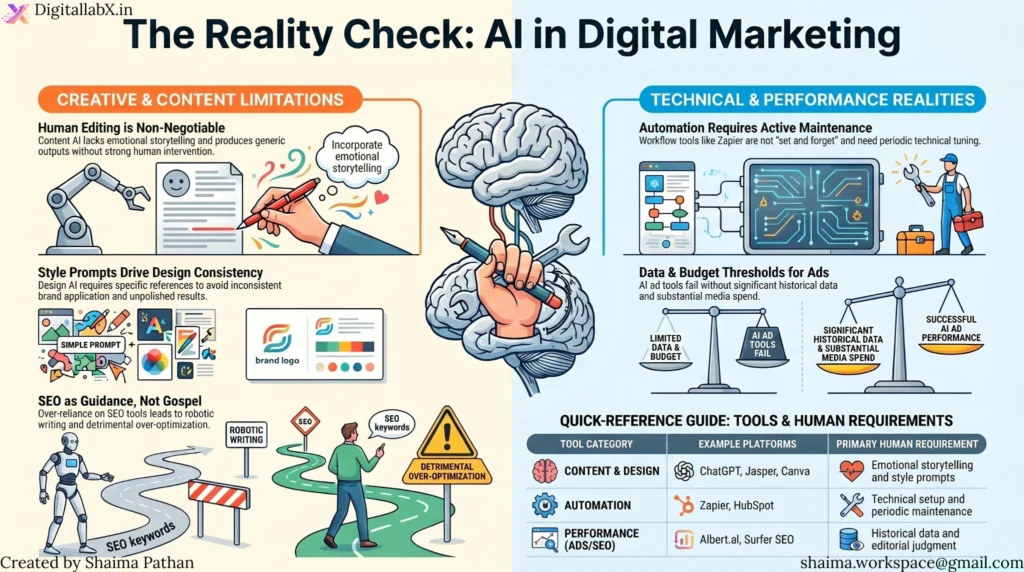
Limitations of AI Tools — The Honest Reality
Every guide that only tells you what AI can do is doing you a disservice. Here’s what each category of tool struggles with — so you know exactly where your human judgment needs to step in.
AI Tools for Digital Marketers in India — Local Context
If you’re a marketer based in India, the AI tools landscape offers a significant strategic opportunity. Here’s why the Indian context matters for your content and SEO strategy.
Why India-first is a smart starting point
- Lower keyword competition for India-specific long-tail queries like “best AI tools for digital marketing in India 2026”
- The Indian digital marketing industry is growing rapidly, especially in tier-2 cities and vernacular markets
- Clients and employers in India increasingly expect AI literacy — showcasing it early puts you ahead
Recommended angle for Indian marketers
Rather than competing with global guides, add India-specific context to your content: local pricing (which tools have INR plans or free tiers), local use-cases (clinics, coaching businesses, D2C brands), and India-specific platform behavior on Instagram, YouTube, and WhatsApp.
Pro Tip — Geo + SEO Strategy
Write content that’s globally relevant but India-specific in examples, pricing, and case studies. This helps you rank on Google and get cited by AI tools like Perplexity and Gemini when Indian users ask marketing questions.
The Bottom Line
The winners in digital marketing in 2026 aren’t the people using the most AI tools. They’re the people who’ve built the smartest AI-powered systems. Every tool in this guide is accessible, many are free to start, and the learning curve is shorter than most people expect.
Start with one category — content, SEO, or design — build your workflow there, then expand. The compounding effect of an integrated AI stack is where the real competitive advantage lives. Your clients, your employer, or your own brand will see the difference within weeks.
Frequently Asked Questions
There’s no single best tool — it depends on your function. For strategy and content, ChatGPT or Claude. For SEO, Surfer SEO. For design, Canva AI. For automation, Zapier and HubSpot. The best marketers build a stack, not a single-tool dependency.
Absolutely. Most modern AI tools are built for non-technical users. Start with Chat-GPT for content and Canva AI for design — both have intuitive interfaces and free tiers. Learn prompting basics and you’ll see results within your first week.
Yes. ChatGPT (free tier), Canva AI (free plan), Google Gemini, and Perplexity AI all have free versions that are genuinely useful for beginners. Paid tools like Surfer SEO and Jasper offer trials — use them to evaluate before committing.
AI helps with keyword research, content structure optimization, topic clustering, and writing meta descriptions at scale. Tools like Surfer SEO guide your content to match what search engines and AI overview systems reward — a critical skill in a world where AI summaries are part of search results.
Using tools is ad hoc — you open ChatGPT when you need it. A system is a repeatable workflow: strategy → research → create → design → distribute → automate. The system produces consistent, scalable results. The ad hoc approach produces inconsistent, time-consuming ones.
For small businesses in India, start with ChatGPT for content and strategy, Canva AI for visuals, and a free HubSpot CRM for lead management. These three alone can dramatically improve your marketing output without significant monthly spend.
